Luxembourg
  Belgium
  Netherlands
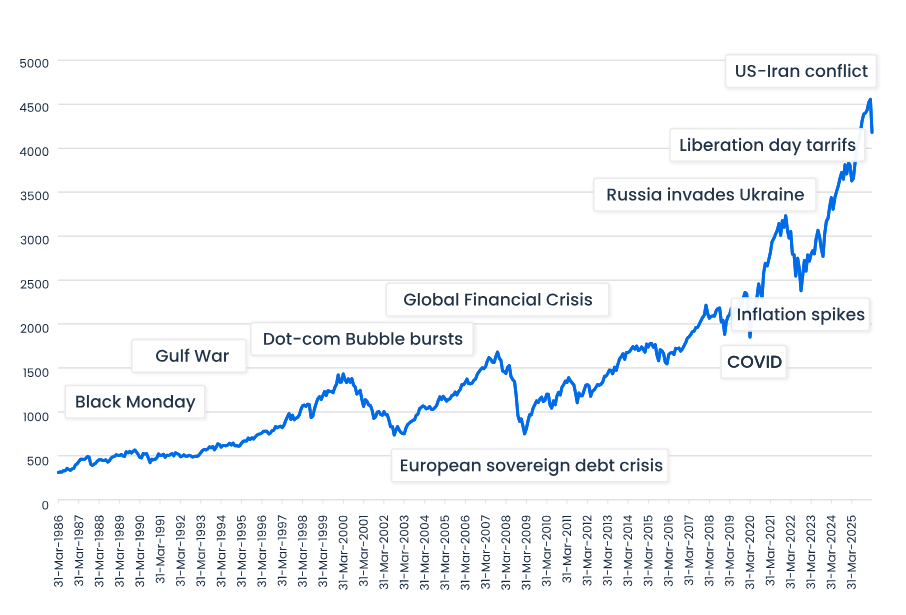
Recent years have given investors no shortage of reasons to worry: a global pandemic, the return of inflation, wars in Ukraine and Iran, geopolitical tensions, sharp interest rate increases, fears of recession and higher import tariffs. At regular intervals, financial markets seem to provide new reasons for concern.
And yet, one conclusion stands out: despite this succession of crises, long-term investors with well-diversified portfolios have achieved attractive returns. Conversely, many people who preferred to wait for “better days” have seen their purchasing power gradually eroded by inflation.
How can this paradox be explained? The answer lies less in the financial markets than in our own brains.
Behavioral finance : when emotion overrides reason
Our brains evolved over a very long period in environments that were very different from the modern economy. Their primary function is to keep us alive, particularly by prompting us to flee when faced with danger. This survival mechanism enabled humankind to thrive for millions of years.
The modern economy, by contrast, is a relatively recent phenomenon. Human beings have only been confronted with complex financial decisions for the past few centuries. This is precisely where the problem lies: some of our brain’s instinctive mechanisms are still not adapted to this reality.
For a long time, economists assumed that investors made rational decisions. Research in behavioural finance now shows that our financial choices are also influenced by cognitive and emotional mechanisms.
This discipline, brought to prominence in particular through the work of Nobel Prize winner Daniel Kahneman, studies the systematic errors we make in our financial decisions.
Here are three particularly common mechanisms, along with several ways to limit their effects.
Loss aversion
One of the most powerful behavioural biases is loss aversion.
We generally experience the pain of losing EUR 100 about twice as intensely as the satisfaction of gaining EUR 100. This can be explained by the fact that gains and losses are processed in different areas of the brain. A loss notably activates regions close to those associated with physical pain.
As a result, our subconscious naturally seeks to reduce the risk of loss.
From an evolutionary perspective, this mechanism makes perfect sense. In the past, individuals who avoided risks were more likely to survive. In the context of investing, however, it can lead to counterproductive decisions.
The illusion of perfect timing
Who would not like to sell just before a market correction and reinvest just before the recovery?
This belief is another common error in reasoning: the conviction that we can repeatedly anticipate market movements.
Even the most experienced professionals recognise how difficult this is. Successful market timing requires two perfect predictions: identifying the beginning of a downturn and knowing exactly when to return to the market.
In practice, markets often begin to recover while economic news remains negative. The strongest stock market gains frequently occur when pessimism is still at its peak.
Investors who wait for absolute certainty generally realise that much of the recovery has already taken place.
Inaction is also a decision
Choosing not to invest often feels like the safest decision. This perception is understandable, but it can be misleading. “Doing nothing” is itself an investment decision and also involves risks.
Consider savings kept in a savings account simply because “this is what we have always done”. This approach may be appropriate for building an emergency reserve suited to an individual’s personal circumstances, often expressed as several months of essential expenses.
However, when high inflation persists, leaving all of one’s wealth in a savings account results in a gradual loss of purchasing power. This is the paradox: the fear of losing money can itself lead to a loss.
During periods of low inflation, this erosion is slow and often imperceptible. During periods of high inflation, its impact quickly becomes tangible. Between 2021 and today, Luxembourg has experienced cumulative inflation of approximately 20%. Over five years, purchasing power has therefore decreased by approximately 20%.
The real question is therefore not only: “Could I lose money by investing?” It is also: “Can I preserve my purchasing power without investing?”
How can we limit the influence of our biases?
Investing remains one of the most effective ways to protect purchasing power over the long term. But how can we prevent emotions from leading to decisions that could compromise our wealth management objectives?
Follow a disciplined strategy
As an investor, your main challenge is often not the market, but your own emotions. Fear may prompt you to sell when markets fall, while euphoria may encourage you to take on more risk at the wrong time.
This is why discipline is essential. Investors who allow themselves to be guided by the news of the day risk selling at the bottom and buying at the top, which is exactly the opposite of a structured approach.
At CapitalatWork, we find that support from an experienced adviser can help investors stay on course at key moments. This is not because investors do not understand the financial markets, but because emotions can sometimes take over when their wealth is at stake.
An adviser helps distinguish market noise from genuinely relevant information, place events in context and remain committed to a long-term strategy.
During periods of stock market turbulence, we help our clients avoid impulsive reactions. The added value of an adviser therefore lies not only in selecting investments, but also in the ongoing guidance provided afterwards.
Resist herd behaviour
Human beings naturally feel reassured when acting in the same way as the majority. In financial markets, however, this reflex can be counterproductive.
When everyone is enthusiastic about an investment, much of the positive expectation is often already reflected in its price. Conversely, the most attractive opportunities frequently emerge when pessimism prevails.
A thoughtful investor should therefore regularly ask the following question:
“Am I making this decision because it is rationally justified, or simply because everyone else is doing the same thing?”
Filter the flow of information
Investors have never had access to as much information as they do today. Paradoxically, this abundance often leads to poorer decisions.
The media, social networks and market experts disseminate a considerable amount of information every day, creating the impression that immediate action is required.
In reality, most of this information has little impact on long-term returns. One of the essential roles of a good wealth manager is precisely to distinguish genuinely important signals from media noise.
Recognise the limits of our knowledge
Many investors overestimate their knowledge and their ability to predict market developments. This phenomenon, known as overconfidence, often leads to excessive trading and excessive risk-taking.
Humility is therefore an often underestimated investment quality. Experienced investors recognise that the future is uncertain and construct their portfolios so that they do not depend on a single prediction.
Build a method rather than predict the future
The objective is not to eliminate emotions, but to establish a method that limits their influence: define your objectives, diversify your investments, maintain a long-term horizon and regularly review your strategy.
As part of this approach, support from an adviser can provide structure, perspective and the discipline needed to navigate periods of uncertainty without losing sight of your wealth management objectives.