
 Luxembourg
  Belgium
  Netherlands
Artificial intelligence is reshuffling the deck in financial markets.
But are market reactions always justified?
While equity indices are trading at record levels, significant disparities are emerging beneath the surface. Some companies are being heavily penalised because of AI, while others are fully benefiting from this technological transformation.
In our new video, our experts provide a nuanced analysis:
- why some presumed “AI losers” may be subject to excessive pessimism
- which opportunities are emerging in AI‑related infrastructure,
- how private markets — particularly private credit — are evolving in a changing environment.
Do you prefer to read the content?
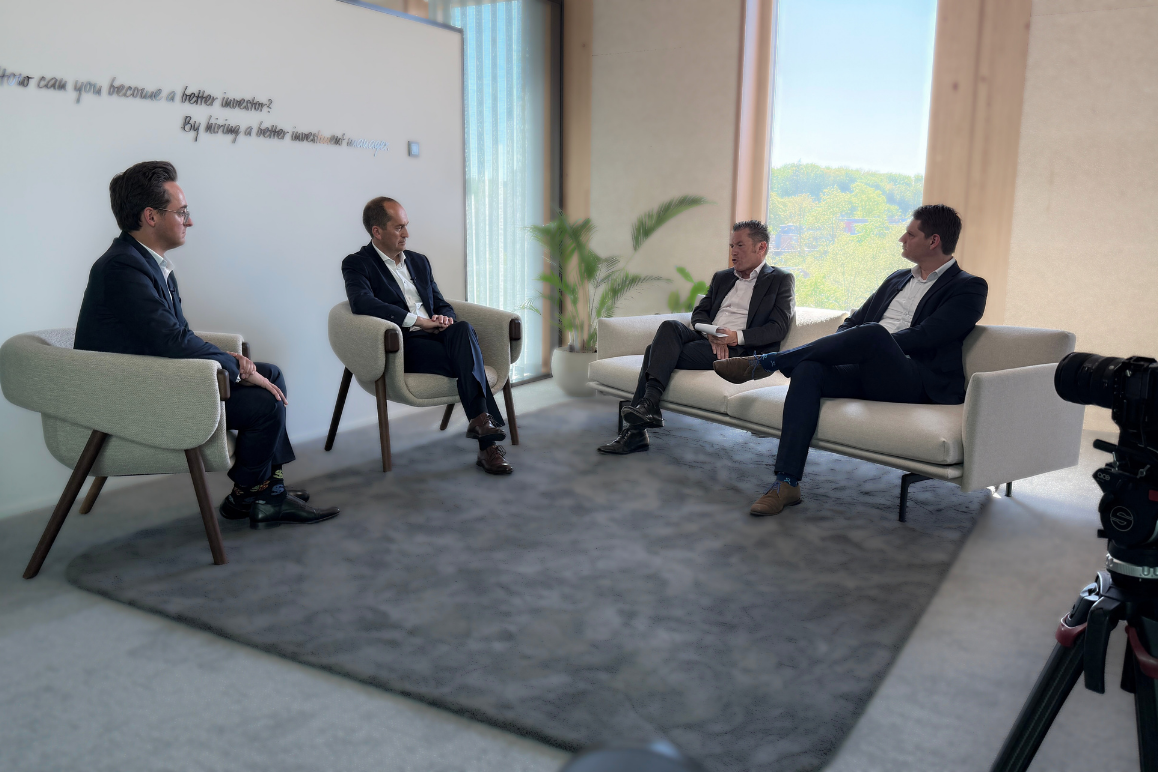
Erwin Deseyn, Chief Investment Officer : For today’s round table, I am joined by three equity managers Michael Geeroms, Tom Van Ginneken and Christophe Pirson. It’s an interesting moment to stop and dwell a little bit on our equity investments, especially given the conflict in Iran and the exceptional, for many investors, resilience that we see in equity markets.
It seems to be relatively smooth sailing so far this year, but a lot of things are going on, of course. So still nothing is as it seems. What stood out to you so far this year, besides the obvious volatility in markets that we have seen ?
Tom Van Ginneken,Fund Manager : Thank you Erwin. Indeed, while it may seem relatively smooth sailing on the surface, with equity markets reaching all time highs again, if you actually look what’s happening under the surface, we’ve seen some pretty violent moves.
One of the things that really stood out to us was the underperformance of what the market perceives to be AI losers. Now the market is worried that AI will, over time, fundamentally disrupt the business models of some companies. And that’s very evident if you look, for example, in the software markets with the North American software indices, for example, being down nearly 30% year to date at some stage.
But it’s not only confined to software, you can see that in other pockets of the market as well, for example, in parts of the financial services industry.
Now, to be very clear, we do believe that AI will have a profound impact in the future, and that these capabilities of these models have improved significantly. Look for example at Claude Code, at Cowork or even at OpenClaw.
And we believe these capabilities will also continue to get better in the future. But what we do not agree with is the way that this has been translated in the market with a rather indiscriminate and very harsh sell off that did not differentiate enough between the companies that were most at risk and those that may be less at risk.
Erwin Deseyn : Well, when I hear you say the words indiscriminate, indiscriminate sell offs probably also refers to potential opportunities, especially for people active managers like ourselves that tend to look at these moments also as opportunities. Can you explain that a little bit to us as well ?
Tom Van Ginneken : Absolutely. And that’s exactly the reason why we’ve been doing the work, trying to figure out for which companies the market is currently perhaps overestimating the disruption risk, or, in other words, to find those companies whose competitive MOATs may be more durable than the market is currently expecting, even in an AI world.
And that can be driven by numerous things :
- For example, companies whose solutions are deeply ingrained in the workflow of their customers ;
- or companies that provide a system of record for their enterprise customers ;
- could also be that companies have solutions that are rooted within proprietary information that’s very difficult to replicate ;
- or because they simply enjoy network effects
And so that’s really an area of focus that we’re looking at, trying to identify those companies, especially when they are valued at quite attractive valuations, if you can look through this near-term volatility. Well, one thing is, of course to have a focus on a potential disruption.
Erwin Deseyn : AI losers, if you can call it like that. But, of course, there is also the pretty obvious fact that there are AI winners and, companies that are allowing these disruptions and probably there are some opportunities in there as well.
Michael Geeroms, Senior Fund manager : Exactly Erwin. So when we talk about AI winners today, you are actually mostly talking about what we would call AI infrastructure companies.
I would say the overarching idea of AI is that over the long term, it’s going to help a lot of companies being run more efficiently, become more profitable.
Whether you’re talking about a bank, an insurer, a healthcare company, they’re all going to improve their profitability due to AI. But that’s not what we see today. Today, we are really still in a phase where we are aggressively building out the underlying infrastructure that is needed to actually run all these AI models.
So basically, in short, data centers. Now, building a data center is not very easy. You have to build big buildings. They are full of chips. There are different kind of chips. They need to be cooled, so you need cooling systems. They need to be connected, so you need networking solutions.
There is a whole ecosystem around building out data centers. And it is until now mostly all these kind of companies connected to this buildout that have profited until today. Now, I want to stress one point when we talk about AI infrastructure names, we’re not talking about one simple, a static list of companies that profit or do not profit. This is a whole, what I would call, a buildout cycle.
And we’ve seen, for example, more at the start, at some point we had a GPU shortage. So graphic processors that were not enough, so these prices exploded. In a later phase we saw a memory chip shortage, so these prices also exploded. And more recently we’re seeing a CPU shortage.
CPUs are also still very important in the buildout of a data center. So the point being there are different kind of companies that offer different services and different products, and they have profited at different times in the cycle to a different degree, depending on what their exact role is in this cycle.
Erwin Deseyn : Very interesting. When you mentioned the word cycle, inevitably it makes me think about valuations as well. Probably these valuations also evolve over time. So what about the opportunities that you see right now in this space ?
Michael Geeroms : Well, as an investor, that’s the main question you always try to answer. Of course, where are the opportunities?
I would say, if you look at the global level, it is relatively clear that the global push to continue this infrastructure buildout is still in full swing, and it’s probably still in full swing for the next one, two, three years, something like that.
There are a couple of indicators that you can follow to support this thesis, most notably the CapEx projections of the large hyperscalers. So meaning the large predominantly American companies, what they intend to further invest into this buildout over the next few years.
They continue to go up and they go into the hundreds of billions. They are an important player, but not the only one. There are also private companies, and you have also an increasing role, for example, for governments that want their own government owned, built, financed data centers.
So the the demand for the buildout is expected to continue to increase. So if you assume that this global trend will continue, then you ultimately go back to the same question, which companies or subsectors are going to profit from this today?
And we definitely see several, let’s say, pockets of opportunities across the chain. And I would even add that even new pockets are regularly added. For example, over the last few months, the technology of photonics, for example, has gained more traction.
So it’s a technology that uses light to guarantee a high speed transfer of data. So it’s become more and more clear that this technology is going to play an important role in data centers to make them overall more efficient. So as active and unconstrained investors, basically, there are always opportunities to be found. Thank you Michael.
Erwin Deseyn : Maybe enough about AI. It is as if there is nothing else in the markets. But of course, there are a lot of other interesting topics. One that quickly comes to mind also is the stress that we hear from in private markets, means private equity, but especially private credit markets. That is something that has been going on for quite some time now and which from time to time is also disturbing investors. So it’s a bit puzzling what is going on there. We, of course, are only invested in liquid public equities and bonds, but we have an indirect exposure also because we are invested in some companies that manage private assets. And there as well you see some indiscriminate movements up and down in that space, while we know from our work that, of course, all those companies are different. Can you explain a little bit what is going on there, Christophe, and what the opportunities maybe could be?
Christophe Pirson, Senior Fund Manager : Certainly, Erwin. As we all know, the private equity and private credit is a big part of the investing world today.
And especially since 2008, the banking crisis at that time, and the growth was quite significant. And of course, such a high growth can also bring some problems, some issues.
And I see three issues that probably explain the current stress period that we are living in :
- And the first issue is probably the concentration or overconcentration to one sector, which is the software companies. We all know that a big chunk of those private loans were dedicated to the software companies. We know that software companies have recurring revenue, high profitability, customer switching costs. And so it’s a great sector. But in the same time, with the rise of AI, maybe their business model could be challenged or could be at risk also. So we see today that the private loans made to this sector are quite suffering for the time being.
- The second issue could be also the liquidity problem, because we also know that more and more retail investors are investing into the private credit and private equity lines. This is called the retailization of the private investment. But we know that by definition, private credit and private equity are illiquid. But in a stress period, retail investors can also ask for early redemption. And sometimes there is a mismatch between what retail investors really need and the characteristics of the private credit and the private equity.
- And the last issue is what is called the refinancing wall. Because most of the private loans were issued in a low interest rate environment, and those same loans have to be refinanced between this year and 2028, but of course, at a much higher interest rate. And that could also cause some problem to these companies, and that could also impact their financial health. So we have three main issues affecting private credit, private equity as of today.
But at the same time we have also some positive characteristics, with regards to private credit and private equity. We know that the private equity manager, asset manager are probably more immune against the pricing pressure and especially the management fee rate, compared to the traditional asset manager like we are. This is one positive point. The second positive point is that most of these asset managers have also an retirement insurance arm that could be a great funding source also.
And then also, and this is the case in the US, most of the retirement savings plans will be allowed to invest more and more assets, more and more of their assets into the private equity and private credit. So there are positive points, more structural, more long term characteristics. But we have also some negative points that create the problem that we are seeing as of today into this industry.
Erwin Deseyn : Well, gentlemen. Tom, Christophe, Michael, thank you very much. Very insightful. I have to say I have maybe two main takeaways from our round table. The first one is an impressive and deep knowledge about what we invest in, which is of course important for an active manager like ourselves that has the ambition to choose where we invest the money of our clients and not simply copy benchmarks or indices. So that deep knowledge is, of course, a foundation. And then secondly, linked to the volatility that we touched upon, the indiscriminate sell offs that we saw in some software stocks, that we saw in some private equity or debt companies, opens up opportunities, especially for an active investor like ourselves. With this deep knowledge of these companies and with an idea of a proper valuation. So thank you very much for sharing all that with us.
Should you need further explanations on these subject and our approach, please do not hesitate to contact us.