Luxembourg
  Belgium
  Netherlands
Inflation is not simply a passing phenomenon. Behind the sharp rise in prices over recent years lie profound structural changes that are reshaping the global economy.
From deglobalisation and demographic shifts to the energy transition, digitalisation and rising public debt, in this video, Christophe Van Canneyt, Chief Economist, examines the forces that are likely to keep inflation higher than many investors expect, and the implications for long-term investment strategy.
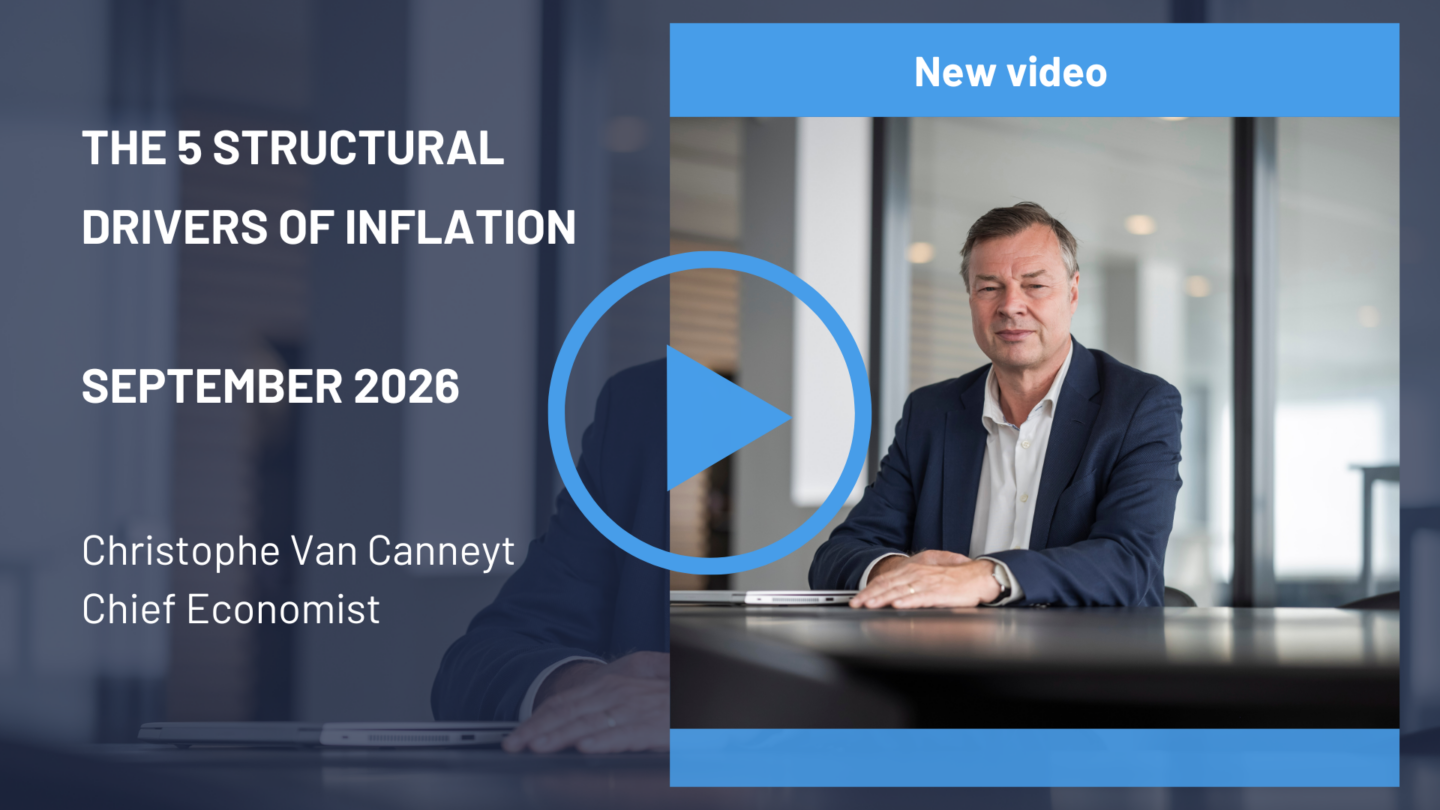
Read the transcription of the video
Inflation is a topic that concerns us both from an investment perspective and from a broader societal perspective.
If we look around us, one thing is clear: the price level today is significantly higher than it was just a few years ago. In Belgium, prices are approximately 28% higher than at the end of 2019. Similar developments can be observed across the Western world. In the United States and the United Kingdom, for example, price levels are roughly 30% higher than they were at the end of 2019.
Conventional explanations point to Covid-19, the war in Ukraine, or more recent geopolitical tensions affecting energy markets. These events have undoubtedly contributed to inflationary pressures, particularly through higher energy costs, which eventually feed through to consumer prices.
However, this explanation does not tell the whole story. The price of oil today is close to where it stood at the end of 2019, yet overall prices remain substantially higher. While natural gas prices in Europe are still above pre-pandemic levels, this is not the case in the United States, which has also experienced significant inflation. Clearly, other forces are at work.
To understand what is happening, we need to look beyond short-term events and focus on the structural trends that are reshaping the global economy. We refer to these forces as the “Five Ds”.
Five structural trends
Deglobalisation
For decades, the world moved towards ever greater economic integration, with countries and companies trading freely across borders in search of the lowest costs.
Today, we are moving towards a more multipolar world in which security of supply often matters more than the lowest possible price. Companies are adapting their supply chains, holding larger inventories and reducing their dependence on certain regions or suppliers. They also have fewer opportunities to benefit from labour-cost arbitrage, while lower levels of competition have increased pricing power in some sectors.
All of these factors contribute to structurally higher prices.
Demographics
Many countries are transitioning from a growing to a stabilising, and in some cases declining, working-age population. As labour becomes scarcer, employees gain greater bargaining power and are increasingly able to negotiate higher wages.
While this may be positive from a social perspective, higher labour costs are often reflected in the prices paid by consumers.
Demographic trends are also driving increased demand for healthcare services, which has resulted in healthcare costs rising faster than many other areas of the economy.
Decarbonisation
Over the long term, the transition to cleaner sources of energy may help reduce energy costs. However, before these benefits can be realised, significant investments need to be made.
Building renewable energy infrastructure and transforming existing energy systems has proven more expensive than many initially expected. These investments are currently creating upward pressure on energy costs.
Since energy is required for virtually every economic activity, higher energy costs inevitably affect the broader economy.
Digitalisation
The rapid development of artificial intelligence and the growing demand for computing power have triggered a massive wave of investment in technology infrastructure. Demand for semiconductors has increased sharply, pushing chip prices higher.
This matters because semiconductors are now essential components in almost everything we buy, from smartphones and computers to vehicles and household appliances.
As a result, digitalisation is also contributing to inflationary pressures.
Debt
The fifth and perhaps most overlooked factor is Debt.
In our view, this is the elephant in the room.
Following the global financial crisis of 2008 and the European sovereign debt crisis that followed, central banks and governments injected unprecedented amounts of liquidity into the financial system. The objective was to lower interest rates and keep debt financing manageable.
That excess liquidity remained in the system for many years and is now finding its way into the broader economy. In effect, it validates and reinforces the inflationary pressures created by the other structural forces.
In a sense, one could argue that we are today paying the price for years of excessive public spending, rising debt levels and the extraordinary policy measures implemented to address past crises.
What Does This Mean for Investors?
The consequences for investors are significant.
At the end of 2019, interest rates were around 1%. Since then, prices in Belgium have risen by approximately 28%. An investor holding traditional bonds would have received around 1% per year in interest while losing a substantial amount of purchasing power to inflation.
In real terms, that investor is considerably poorer today than five years ago.
This reality has strongly influenced our investment decisions.
We recognised early on that inflation was likely to prove more structural than markets anticipated. This led us to allocate a significant portion of our bond portfolio to inflation-linked bonds.
These securities are specifically designed to compensate investors for inflation. They adjust with the evolution of consumer prices and therefore provide a natural hedge against rising inflation. Over recent years, they have delivered significantly better results than traditional nominal bonds.
We continue to hold these securities today because we believe inflation is likely to remain higher than current market expectations suggest.
The Ultimate Hedge Against Inflation
Ultimately, the best protection against inflation is not a financial instrument but ownership of high-quality businesses with strong pricing power.
Companies that can successfully pass on higher costs, whether for labour, raw materials, semiconductors or supply chains, are able to protect their margins and profitability. As shareholders, investors benefit from that resilience.
Identifying such companies has always been a key element of our investment philosophy and remains one of the most effective ways to protect purchasing power over the long term.
Inflation may have retreated from its recent highs, but the structural forces behind it have not disappeared. Understanding these trends remains essential for investors looking to preserve and grow their wealth in the years ahead.